
~Jeanette Winterson (British Author; Oranges Are Not the Only Fruit)
Fertilized
 I spent the day Monday fertilizing most of the winter-blooming flowers at RMH. It might seem odd to be doing this during the cold, rainy weather, but a little help for plants like primroses, camellias, and cyclamens really helps with flower production.
In general I have an ambivalent regard for fertilizing, even the predominately organic approach we use—I understand the important role that supplements have on plants, but I try not to push plants too aggressively. Basically, I like to allow plants to be what they will be in a mostly “natural” state. So, I amend, compost and mulch and add organic supplements to give them a boost.
I really avoid non-organic approaches because I find the value of having a “super” plant is limited. For example, the leaves and structure are usually weaker in a plant that grows too fast, flavor is less interesting in a “forced” plant, and the fruits are typically less than impressive if a plant was coaxed too aggressively.
That being said, a plant’s destiny is to produce more plants through fruit, seeds, rhizomes and the like, and they typically achieve this through the minimum effort required for its botanical history and development.
So, flower development is only required to the point that it will attract the appropriate pollinators. Small bloom, large bloom, bright color, height, all of this is dependent on past natural selection and current growing conditions. Therefore, to get impressive flowers by human standards often requires some assistance such as, in our case, organic fertilizers.
Primroses can get by with small, low, but colorful flowers at this time of year—not much else is available to compete with them for insects at this time of year. However, I’d like a bit more heft and height to the flowers for the same reason, fewer plants blooming at this time of year. Don’t get me wrong, I DO enjoy the increased impact that a hit of phosphorous gives to the flowers on a plant, but it does get me thinking.
When should we “boost” something? Too much forcing can result in a weaker plant, less resistant to insects, with less flavor. In effect, the essence of the plant is more “artificial” or manipulated. (To generalize without overstating.)
It’s all about finding a balance between the natural desires and capabilities of the plant and the human, cultural desires that we have for plants. A primrose isn’t going to put more energy into making flowers than it has historically needed and/or is capable of given current conditions, so, a bit of fertilizer gives it more to draw on, allowing it to expend energy in making even more successful flowers.
I find a lesson in all of this. We should seek to find a similar balance in our lives between what is our true essence and capacity and the personal and cultural expectations we feel (real or perceived).
When are we pushing ourselves unnaturally just to meet external expectations? Or applying those same expectations to others? When are we “boosting” ourselves “organically” versus applying all-out, high-octane efforts that will stress and strain us?
I find all flowers beautiful, even those unaided by human manipulation. However, there is something particularly nice about seeing bursts of color here-and-there in the winter garden, but I try not to push too unnaturally hard.
Bobcat
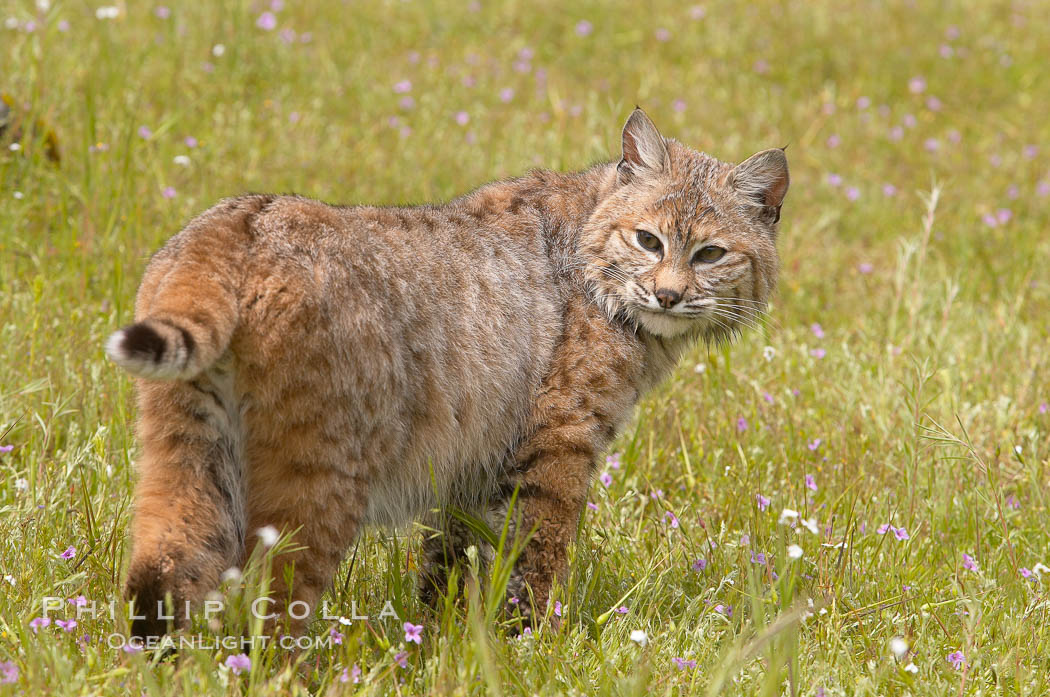
Bobcat, Sierra Nevada foothills, Mariposa, California
What do bobcats eat in the winter? Well, we almost had a chance to see for ourselves when one was stalking RMH the other day.
Though they are reported to range from 11 to 33 pounds, this particular one that visited us seemed even larger (though, we did not in fact try and weigh it). It did however have absolutely classic bobcat features…and it was hungry.
Apparently, hungry bobcats are much bolder, disregarding all indications that it was hunting around our house at 11AM, quite freely hopping over the fence around the pool area. Seems it was sure that Percy, our wandering, cage-less peacock would be a particularly delightful snack. Oh, it turns out that peacocks are in fact a great early warning system for some situations…like a bobcat in the yard.
Mouth watering, “Bobby” (or Bobbie, we didn’t check the sex either) sprang from his/her crouch toward the honking peacock; however, this particular cat was clearly uninformed on the nature of pool covers and wound up taking a chilly dip. Meanwhile, Percy had sprung for the roof, continuing his loud warning honking.
The cat slunk off before we had a chance to get the camera in position and hopefully has reconsidered our immediate front yard as a hunting ground.
The whole scene was utterly spectacular, a veritable “RMH Wild Kingdom.” I get a deep primal thrill with all the various opportunities to experience nature at RMH. And, though I am cautious by respecting nature, I really believe that we shouldn’t fear it. I don’t want our two pet dogs to become a meal opportunity, but I don’t roam about in fear or dread. Plus, drawing on the Disney concept of the “Circle of Life,” there’s a balance that must exist in nature, and that includes hungry bobcats.


No comments:
Post a Comment