Friday, December 9, 2011

Gathering The Holidays


Last time out, we were gathering greens from around the property for a holiday display (pine, bay, Toyon, aka Christmas Berry). Today we've gathered some bunches of another native, mistletoe. It's interesting that it came to represent kissing (berries were plucked from a hanging bough, each allowing one kiss), given that it is a "hemi-parasitic" plant. (Hemi-parasitic means it is half parasitic, attaching itself to tree branches, oak here, but sill able to do photosynthesis.)

Mistletoe is the common name for obligate hemi-parasitic plants in several families in the order Santalales. The plants in question grow attached to and within the branches of a tree or shrub.


There is quite a bit of history and lore attached to the plant around the holidays.


Happy Mistletoe and Happy Holidays!

~Timothy

Saturday, November 19, 2011

Let's Talk Turkey!

We've mentioned our resident rafter of wild turkeys here a number of times. (Yes, "rafter" is a term for a group of turkeys.) Given the time of year and the fact that I saw a fascinating documentary about the bird, I'm inspired to spotlight them again.

Last night I watched "My Life as a Turkey," an episode of the PBS program "Nature," based on naturalist Joe Hutto's true story chronicling his remarkable and moving experience of raising a group of wild turkey hatchlings to adulthood.

He was seeking to understand the science of imprinting which "refers to a critical period of time early in an animal’s life when it forms attachments and develops a concept of its own identity." In essence, Hutto became mother to a brood of turkeys.

The Wild Turkey is quite an interesting bird and fairly different from the domestic turkey you might have "visiting" this Thanksgiving.

(Apologies to my vegan and vegetarian friends if there is anything in the following that suggests a turkey is anything but a wonderful example of native wildlife or a delightful pet...for your additional enjoyment, here is some information on the Wild Tofurkey and a delightful source of inspiration for a vegetarian Thanksgiving!)

NPR's A Vegetarian Thanksgiving story

A Vegan Thanksgiving Dinner (vegatarians welcome!)

OK, now that they are distracted I'm just going to say it, the turkey you will...um..."share" Thanksgiving with next week isn't much at all like its wild relative and very different from those eaten in early America. (There isn't actually certain evidence that turkeys were consumed at the "first" Thanksgiving; however, when the holiday was formalized as an official American holiday in the mid-1800's, turkey was definitely consumed at holiday meals.)

Domesticated turkeys are the over-bread, in-bread, "couch potato" cousin of the more agile and elegant Wild Turkey. Whereas the wild bird can run (quickly in bursts) fly for short periods (at the freeway speed limit if required), and can live for about 4 years, the domestic turkey is absurdly bulked-up, front heavy, barely able to move, incapable of flying, and lucky to live more than 6 months. The domestic bird has also lost all of the beautiful brown and gold coloring that helps camouflage its wild relative, leaving it with a mostly white plume. (More info. & source)

So, if you are prone to...um...invite a turkey to Thanksgiving and like to know from where your...um..."guests" are procured, I hope you found this interesting reading. (Are the vegans back yet??)

One last thing...

Mr. Audubon himself had quite a bit to say in his field notes about the Wild Turkey, along with a beautiful drawing of the bird (as he is of course well-known for producing).

The "Perfect" Fall Garden


I recently read a letter sent to one of my gardening magazines (yes, yes, I understanding the implication of having subscriptions to "gardening magazines") presenting a couple's dilemma regarding how to maintain their flower garden at this time of year. (The vegetable garden, of course, having been cultivated with planting for fall/winter produce.)

One half of the couple wanted to clean and trim so the garden looked "tidy," while the other wanted to leave the plants a bit longer so they would be more natural. I definitely agree with the "natural" approach.

Plants have a mission--to grow and produce to ensure perpetuation for the next season and/or next generation. Who am I to argue?

I like to let plants set and distribute seeds (even if they are just distributed to birds and squirrels), including the delightful (and tasty!) rose hips of our many rose bushes. And bulbs, tubers, corms need the energy produced by their leaves to prepare and store energy for the long winter and spring emergence. (As just two examples.)

So, I say it is fine to be a little rough around the edges when making a transition... from Autumn to Winter.


HAPPY THANKSGIVING!!

~Timothy

Friday, October 28, 2011

ABUNDANCE OF HUNGER

This being the harvest time of year, culminating with Thanksgiving, it is of course very natural to think of the cornucopia of fruits and vegetables that have or are being collected from the gardens and farms in the area. As I reported in my previous post, though the weather was atypical most of the year, there were still many wonderful crops to gather.

It has also been a particularly great autumn for the fall garden, and it’s clear there will be a nice supply of cold-weather vegetables for months.
For me, it’s also a great time to reflect on those who can’t celebrate abundance at this or any time of year.

Nearly 17% of people in America experience hunger, or food insecurity, including 23% of all children in the country without enough to eat.


According to the Redwood Empire Food Bank, in Sonoma County, 78,000 people face the threat of hunger every month:

  • 34,000 are children

  • 11,300 are seniors

  • 13,500 are working families

  • The median monthly household income of food recipients is $930


And they continue: “children make up the largest group of those at risk of hunger in our community. There are 9,762 children living in poverty in Sonoma County according to the latest statistics from the U.S. Census Bureau. Seniors living on fixed incomes represent another large segment of the population the REFB serves. For 61.4% of our senior clients, Social Security is their primary source of income.”

It is a common reaction to be astonished that so many people go hungry in a country with such abundance—but people can’t eat a reaction.

I recall vividly the times in my life that I have worried where my next meal would be coming from and had to make limited dollars stretch. In fact, growing up our family was briefly on welfare and food stamps, and, looking back, it is clear that our single mother had to get creative in how she was going to get food on the table. (Ask me about the joys of “green spaghetti”—a truly fun & entertaining experience for us kids, but a creative attempt to combine cheap bags of pasta, powered pesto and cooking oil to feed 8 hungry kids.) But I’ve never had the thought that I would not be eating for an extended period of time or that I would have to regularly skip a number of meals.

Try not eating for a day and see how you feel.

You may get a sense where this is going and already feel that, as bad as the situation may be, you just couldn’t possibly face yet another appeal to make a donation. And, if you simply can’t give cash, food, or time, I understand and that’s OK. However, if you can give, I’m asking you to take the time to give as much or as little as you can.

You would be AMAZED how well food banks can use donated dollars—it is truly spectacularly efficient.

A donation of just $25 helps food banks provide 100 meals, so a child could eat for a month, or a family of 4 could eat for over a week. Alternatively, you could drop a food donation in a food barrel or volunteer 4 hours to help a food bank or other organization pack food boxes. In the last month, I downloaded $25 of music from iTunes, drank $25 in diet Coke, and spent that much the last time I put gas in my car.

The Redwood Empire Food Bank has the most amazing set-up allowing you to shop online for a large variety of food items at their wholesale cost. You literally can choose and calculate any amount of a donation.

If a family came to your door and told you their kids had not eaten for 2 days, asking if you could spare anything, wouldn’t you give them a box of pasta or cereal? Well, now you can do that virtually through the link below.

You can really count on your donation making a difference.

Feeding America fights hunger nationwide:


Happy Abundant Harvest!

~Timothy

Saturday, October 1, 2011

Seasonal Friends

Live each season as it passes; breathe the air, drink the drink, taste the fruit, and resign yourself to the influences of each.

The Autumn counterfeited Spring
With such a flush of flowers,
His fiery-tinctured garlands more
Than mocked the April bowers,
And airs as sweet as airs of June
Brought on the twilight hours.
~Dinah Mulock Craik

When Summer gathers up her robes of glory,
And, Like a dream of beauty, glides away.


I really enjoy the times of year during the transition of one season to another, a bridge between the phases of nature's inevitable advance. These days, I experience it most profoundly when I am out working in the vegeyard and am seized by a profound awareness of recognition--a seasonal déjà vu.

After months of growing comfort, working to become in tune with the unique personality of the current season, it's invigorating to get a whiff of the approaching season--like a good, old friend when you think you caught a glimpse of them across the street, or a remarkably familiar smell that suddenly forces a sharp, visceral recall into your consciousness. (With my grandmother, it's certain smells of hardy "old school" cooking or Lysol, reminding me of the process of cleaning the garbage room of the apartment building she managed with my grandfather.)


Of course, since September 23 was the equinox, we are now in the early days of Autumn, with the various temperature extreme this time of year brings--sweatshirt in the morning, t-shirt in the afternoon (and, of course, sun screen)--only more so this year!


We've just finished an unusual heat wave that had gardeners and growers in the area stressing about heat stress, resulting in this warning from Sonoma County Master Gardeners


Now that everyone has switched gears to dealing with the heat wave and the water stress that it produced (it also produced some ripe tomatoes and melons!), we have to switch gears again and prepare for some early rain. The weather forecast calls for rain for the first half of next week. If you are planting a winter vegetable garden, get your starts in ahead of the precipitation. You may need to protect the young plants with some Remay or overturned pots if we really get the stormy conditions that are forecast.

(from their Facebook page ...of course!)


Severe Weather Alert!!


So, this is all well and good, but in addition to the warning from the Master Gardeners, the Weather Channel issued a “severe weather alert,” complete with flashing red graphics and such on their site:


... EARLY SEASON RAIN EXPECTED NEXT WEEK ACROSS NORTHERN AND CENTRAL CALIFORNIA...

SIGNIFICANT CHANGES IN THE WEATHER ARE FORECAST TO OCCUR DURING THE FIRST HALF OF NEXT WEEK AS A STRONG EARLY SEASON PACIFIC STORM SYSTEM TAKES AIM AT NORTHERN AND CENTRAL CALIFORNIA...


So, as I’ve mentioned before, it has been an odd weather year (both this and last) that is having a pretty significant effect on how things grow. Change in weather, change in climate, caused by human activity...what I can say for certain is that if these changes remain constant, what we eat when will be affected, as will the cost of food.


Lesson Learned!!

One of the joys of gardening in Sonoma County is growing chiles (or chili or chilli) of many different varieties. The hotness of chiles is rated on the Scoville Scale and is dependent on how much capsaicin is in the fruit. Recently I learned a lesson in the intensity of the Scoville Scale and a bit of humility regarding what I will shove in my mouth without thinking it through.

I took a bet with one of the guys helping us out with some work here at RMH to trade and try hot chiles that we grew. Seems he eats very hot chiles every day for lunch; however, I on the other hand will typically only use them for cooking.


He ate the one I grew like it was candy, so it was my turn. Being small, I ate it in one bite. At first it has a fresh taste and a mild warming sensation. Turns out the chile is referred to as El Diablo, and it lives up to it’s reputation. First I felt a slow, steady burn develop as it I had taken a mouth full of a hot beverage that was uncomfortable but not burning. Ahh, if only it had stopped there. Very quickly, it began to feel like I had taken a mouth full of some chemical that wasn’t supposed to be consumed, and, even more quickly, I began to worry that I would soon be experiencing blistering. Ahh, the calming effect of the fat in several glasses of milk...lesson learned.


Like Buttah

Didi and I had a fund day on Thursday turning our RMH organic pear harvest into Spiced Pear Cardamom Butter, using a great recipe from Organic Gardening [LINK: http://www.organicgardening.com/cook/spiced-pear-cardamom-butter]. We look forward to sharing it over the coming holidays.


Reminder of Upcoming Events at RMH in October


October 22: Fundraiser for the Redwood Empire Food Bank

October 29: Eerie but Elegant Winemaker Dinner featuring Moshin Vineyards


Happy Autumn!

~Timothy


Saturday, September 10, 2011

Fakin' in the fields


Every time I drive 101 (not *the* 101...I grew up in the bay area and know how we refer to our freeways) between Sonoma County and the bay area, I raise my fist in exaggerated (mock) anger just north of Petaluma and shake it at a field of pumpkin vines (and not just because the field seems to cause a slow down of gawkers that momentarily ties up traffic).

You see, they purport to give a "farm-to-home" experience of picking your own pumpkins for the holidays, but it is a manufactured experience. Now, they may in fact grow the pumpkins you'll find in the field, but they don't do it there. The pumpkins that will be available in a few weeks are brought in from another location and placed strategically in the field for the "pick your own experience."

About a month or so ago, they planted their squash vines and corn stalks and have clearly been fertilizing them for rapid growth, but this is far too late in the season to plant if they plan to harvest produce. You see, the corn is just for a corn maze, and the squash vines are to give the illusion that they produced the pumpkins that will soon be manually placed in the field.

Now, far be it for me to ruin the truly joyful experience of children running through the field looking for the perfect great pumpkin. I think that walking around in dirt looking for produce to "pick" is a truly important experience in helping connect us to the produce we use.

But the field is fake, doesn't produce what people are "picking," wastes a tremendous amount of water (and likely fertilizer and pest control efforts) to produce vegetation for show. It would be one thing is the corn was grown for food before being turned into a constructed maze and the squash vines were grown correctly to produce some fruit, even if is were supplemented with some showier pumpkins. In fact, the squash isn't planted at the correct time to even produce fruit, and the size of vines people will find on their forays into the field could not produce the size nor volume of pumpkin that will be found.

With the growth of true farm experiences in the area connecting with the desires of so many people to truly understand how their food is grown, I just think a faux farm experience undercuts the authentic farming experiences in the area and hurts the growers by suggesting it's as easy as it will seem in this fake growing field.

Fry those green tomatoes?

Of late, I’ve been researching pickling recipes for the abundant crop of cucumbers this year and have gotten a good feel for dill pickles (and a particularly great cold cucumber soup served recently at RMH to great acclaim). However, I am starting to fear that I may have to turn to pickling my still-green tomatoes.

The cherry tomatoes--sun gold and chocolate--have been producing for a couple of weeks, but I'm still waiting for the other varieties. Patience being a virtue and all hasn't always been my strongest character trait, but as I have learned many times in many ways, gardening teaches lessons.

It’s common understanding that this has been a particularly cool summer.

According to AccuWeather:


Already having one of the coolest summers of its climatological record, California will begin the week (August 8) with more unusually cool weather.

One of the things I enjoy is heading to the various nurseries in the area and trading stories of our growing experiences. One of the employees at one of my favorites and I continue to marvel that we have big, beautiful pumpkins about ready for harvest before our tomatoes have come ready.

On the other hand, our unusual weather seems to have made it a fantastic year for pears--more of each of the varieties we currently grow than in the past several years.

Dahlias

Although it took a bit of time for the sunflowers to really get going,it has been a fantastic year for dahlias. This picture speaks for itself…this is just one blossom that we grew in the RMH flower garden.

Naked ladies everywhere


Great article on the Sonoma County Master Gardners website about this pink beauty that pops up this time of year:

Will the real Amaryllis please stand up?

Redwood Empire Food Bank:

This fall we will be working to support the food bank. It's no secret that in the current economy, more and more people are experiencing food scarcity and nutrition problems--hunger. In my least economically stable times, the worry about where and when my next meal would be available was always a great source of anxiety.

36.2 million Americans–including 12.4 million children–don't have access to enough healthy food to thrive. They are food insecure and at risk of hunger.

In 2010, the Redwood Empire Food Bank served 78,000 low-income residents per month by distributing 12.59 million pounds of food–is the equivalent of 27,000 meals a day.

It really doesn't cost a lot to make a difference in helping feed a family:


Virtual Food Drive

Bay Area Food Banks

First Day of Fall: The Autumnal Equinox

Fall begins in the Northern Hemisphere on September 23, 2011, at 5:05 A.M. (EDT).


Sonoma County Harvest Fair September 30 – October 2

HAPPY AUTUMN!

~Timothy


Thursday, August 11, 2011

The Growing Mind…

“There are known knowns. These are things we know that we know. There are known unknowns. That is to say, there are things that we know we don't know. But there are also unknown unknowns. There are things we don't know we don't know.”
~Donald Rumsfeld


As I sit on the precipice of the start of my 50th year of life (49th birthday), I have come to the realization that I am compelled to re-embrace my roots as a “renaissance man.” (Not the movie directed by Penny Marshall, starring Danny Devito); although, it would be cool if it were the Star Trek Voyager episode …) Also known as a polymath, for this purpose we’ll simply consider the term to mean someone who know some about a lot of things.

Now, many of you who know me must certainly be saying, “why yes, of course, we would expect nothing less…Timothy constantly thinks he knows something about everything,” and yet that would miss the point. With an ADD-brain and a voracious need to know about things, my recent foray into organic gardening has again emphasized the value of my curious and oft-unsettled mind.

At the start, I felt as if I had to know everything about growing—and just the correct stuff, the absolute answers. Over the years, I have learned that there are few absolutes in gardening and growing, and many of those are taken care of by nature. My perspective on this process that has been occurring for millions of years, mostly without human intervention, is entirely subjective, erring on the side of nature.

I fully understand that human cultivation of plants for use and enjoyment has discovered many methods of manipulation that benefit humans (and, coincidently, the plant…I suggest Botany of Desire by Michael Pollan, either the book or the PBS special ).

The history of agriculture dates back thousands of years, and its development has been driven and defined by greatly different climates, cultures, and technologies. However, all farming generally relies on techniques to expand and maintain the lands suitable for raising domesticated species.


I have spent the last several years gathering knowledge, experience, advice, and opinions on growing, and it has allowed me to become a “gentleman farmer”—I have evolved. For example, my perspective from 2007 would have been very concerned about what my tomatoes are doing this year, but know I “get” them. They’re just being tomatoes and responding to the weather, but I have tended them well. The pumpkins? They couldn’t be more “pumpkin-y.” A couple of years ago I tried to harvest coriander seeds and got nada, but now I’m anxiously awaiting little golden nuggets of coriander-ness!

So, my goal for my fifties is to cultivate my life like I have learned to cultivate the land, by knowing how I can exert positive influence to improve the harvest; weed where necessary; work with nature, not against it; and know how to enjoy and share the bounty. Or, put another way, good soil (the medium or environment) makes good roots (the foundation of the plant) which makes good healthy plants (& bounty). You get the picture.

I have come to realize that this is just what I’ve been doing for 11 years with my relationship regardless of any aspects that I can’t control, and I do enjoy the bounties of that cultivation.

Sure, but is it urgent??

“Life's most persistent and urgent question is: What are you doing for others? Living is a form of not being sure, not knowing what next or how. The moment you know how, you begin to die a little.”

~MLK

“What comes first, the compass or the clock? Before one can truly manage time (the clock), it is important to know where you are going, what your priorities and goals are, in which direction you are headed (the compass). Where you are headed is more important than how fast you are going. Rather than always focusing on what's urgent, learn to focus on what is really important.”
~Source unknown


My gardening/farming efforts have also helped me clarify the difference between important and urgent, specifically how most things that seem urgent simply aren’t really.

In general, the most effective and successful people spend most of their time on important things rather than urgent things, specifically things that add measurable value.

Perhaps the only really urgent thing in gardening is to irrigate. Plants can show water stress quickly, especially seedlings and recent transplants. Although established plants are more durable when deprived a bit of water (and some plants actually produce better fruits and vegetables if stressed in just the right way, like tomatoes and grapes for example), when a plant is desiccated from dehydration, it’s difficult to revive.

Oh, I concede that there are many aspects of growing that are very important to successful horticulture, but there in lies the proof of the premise, and, what the gardener considers important may not be the most important thing to the plant. A plant considers it successful to produce fruit that assures a chance at successful seed dispersion, which may not in fact produce fruit that satisfies the grower.

Any sense of urgency in the garden is established in my mind and isn’t always consistent with what is important in the garden that day, in that season, relative to the needs of the plants. I’m learning to be in tune with the garden—the garden and I must be one, perhaps—to observe and evaluate needs and priorities to respond accordingly.

My adoration for Keith Haring has been sparked and is growing. I’ve always deeply appreciated and been moved by his art, and I’ve found his biography and strength of character motivating. As I begin to think more about my 50th year, I’m finding myself ever more moved by his life and work. Cut short in 1990 at age 31, his response to his AIDS diagnosis was bold and brave, and his commitment to turn his work and energy to establishing a foundation is an inspiration. You’ll do yourself a favor is you look at some of his work at the link above—whether you’re familiar with him or not. (Yes, some of his work is rated PG-13, or R, or more, but it’s easy to sort through it on the site, and the foundation has established a wonderful kid-friendly site.)

Reminders:

Upcoming events in Sonoma County

~Timothy

Our Grapes are Showing!!

After only 2 years, the organic River Myst Haven Vineyard is already producing a few grapes! Wine will follow in a couple/few years!


Thursday, July 14, 2011

Don't Worry...Bees Happy...

So, Didi continues to lead us toward bee keeping, and we couldn't be more excited. She has been attending the meetings of the Sonoma County Beekeepers' Association , including the meeting this week where honey extraction was the topic. Also, we just got certified as a bee-friendly property by Partners for Sustainable Pollination, so we expect to be hosting bee vacations soon. Actually, we've been certified as a Bee-Friendly Farm, or a "BFF"...like, OMG!

(You should really checkout the Sonoma beekeepers' site...it has wonderful information about bees, including a different "fun fact" that appears each time you visit or refresh the page.)


Actually, as a result of this, I was inspired to complete an additional round of planting of bee-friendly California native plants--white sage, "bee bliss" sage, mimulus, california wild rose, ceanothus. I'm also experimenting with a native bee box--a chunk of untreated wood with various sized holes drilled in it. It is estimated that native bees carry the burden of some 30% of crop pollination in the U.S.. We certainly see them hard at work here at RMH.


Didi arranged for a local bee guy to bring a working hive to a recent event, and his "girls" as he calls them were a huge hit. It's interesting to know that most bees in a hive are females--generally only 5% of a the bees in a hive are males. They are kept around to mate with virgin queens, don't do much else, don't have stingers, don't really visit flowers, and are kicked out of the hive when they aren't needed. (Again, you really should visit the Sonoma County Beekeepers' Association website link above.)

(So, keep that in mind when you hear Blake Shelton singing about wanting to bee a honey bee to visit the "honeysuckle" that is the girl in his song. Sorry Didi, I had to say it...it's just too good...)

In fact, Michael and Deno, guests at the same party and new friends of RMH, are beekeepers in San Francisco and call their operation the Pollen Princesses for the very reason that the hive is mostly females. They are featured beekeepers in Backyard Beekeepers of the Bay Area , a fascinating overview of the art and joy of tending bees in various unexpected locations.

Hello Deer!


It's getting to be that time of year during which local wildlife tends to wander more in search of food (we think...because of the lack of rain), leading to an increase in sightings on the property. Yesterday we were visited again by a bobcat--smaller that the last one but impressive still. (You might recall that I told about a previous visit this winter.)

There is also a Mule Deer (aka, Blacktail Deer, a subspecies of the Mule Deer) who moved into the area. We've seen it wandering around, munching on shrubs and grasses (and perhaps the occasional watermelon rind tossed out).

We're always impressed with the diverse wildlife menagerie we have on the property and the comfort the animals have for visiting; though we do know their numbers can increase quickly if there is a regular, convenient source of food.


Weather or not...

I just had an email exchange with a friend going through the heat wave in Kentucky. So, not to be too preachy, but the climate change model predicts colder & wetter on the west coast (which we are experiencing) and hotter in the rest of the country (which was the lead news story on the Newshour)...I'm just saying...

Tomatoes and other summer fruits and veggies are still lagging in setting fruit and ripening. The weather has still been chilly overall, especially the nights, again dipping down to the upper 40s. Squash need warmer soil, so chilly nights affect that overall.

I read in the California agriculture newspaper that cherries, plums and apricots are all down about 15% statewide, and we talked to a grower of olives who didn't have any fruit set this year. Disturbing if it continues, and it raises the troubling question of adjusting what we grow in the area if this shift in the weather is ongoing. Easier perhaps for a small grower, but likely to cause some disruption in the food industry.

Happy Ending

We are looking forward (so far) to a bountiful pear and apple harvest. The trees are full, and the fruit seems to be progressing nicely. Expect spicy pear butter in the fall.

Reminder, the Gravenstein Apple Fair is coming up on August 13 & 14, known as "the sweetest little fair in Sonoma County."

Thursday, June 16, 2011

Jammin’

Ted, Didi, Alan & I all got together this weekend to make jam from the bounty of raspberries I harvested over 2 days. I’ve been tending to these raspberries plants since 2007, so it was awesome to be working with the large, juicy fruit that came off the canes, in amounts that kept me in awe.


If you’ve ever bought raspberries from the store (and who hasn’t) you know that they are a rather delicate fruit that can breakdown and get moldy quickly, which makes picking them yourself within a day or two of using them that much more special.

Raspberries are a type of bramble, like blackberries and are also known as “Cane berries”; however, they are different from blackberries in that the fruit has a hollow core that remains on the plant when you pick the raspberry.

(Get more facts on the fruit from a wonderful website called “Pick Your Own.”)


Preserves

Of course, you know that jam is made from the whole fruit, and jelly is made from the juice of a fruit— both of them require a great deal of sugar. In fact, it isn’t really a jam or a jelly without sugar, and these are but two of the variety of fruit preserves.

The sugar is an important part of the chemical process that sets the fruit pectin (a carbohydrate taken from plants) to thicken the jam. In fact, when making jam you are essentially making a candy in that you are melting sugar and flavoring it (in this case with organic fruit). Some fruits are high in pectin and will thicken on their own, but some need to have pectin added.


Naturally Sweet

Since I haven’t been eating processed sugar, I set about exploring another approach to preserving the raspberries by making a fruit spread, that is, whole fruit made like a jam, but without adding any processed sugar.

I settled on a fun recipe for a spiced raspberry spread made with the fruit we harvested, concentrated organic fruit juice, a sliced apple, spices, and lemon zest and cider vinegar for some acid (another important step in processing the pectin in the fruit—see above).

Once I figured out the difference between liquid and powdered pectin—they function the same but will affect the recipe if not carefully interchanged—and saved us from my math error (ounces to tablespoons to teaspoons to cups…oh, never mind!), we were on our way.

Once we had the ingredients in the pots, the trick is to cook quickly, without over cooking, and preventing the boiling mixture from burning.

When Ted arrived, we were able to get an assembly line going to get the bright red jam into jars. (Clean them, warm them, fill them, process them in boiling water.)

The result (for both the traditional jam and the spread) is fantastic. Good color, great flavor, nice set. You’ve heard it before, you just cannot beat just-harvested organic fruit.

As you may know, when the processed jam jars are cooling, it is important that the indent in the lid be sucked down by the vacuum created in a properly-sealed jar. So, while cleaning up (the jam does get everywhere), we had the satisfaction of listening to our many individual jars “pop” with this final sound of success.

So, we had a complete farm-to-kitchen experience. While I thought back on the time I spent tending, cultivating, composting, mulching, pruning, etc., the raspberries, I had a new appreciation for the effort that goes into producing quality organic fruit. And, Alan, Didi, and Ted, can attest to the work involved in producing a quality organic jam and their appreciation for the process.

In short, organic, farm-to-kitchen, is hands-on, but so worth it.


~Timothy

Wednesday, May 11, 2011

Flying Time

Hmmmm. So long since my last blog…did you miss me??

It’s been busy in the garden with much spring planting to do, so forgive me if I’ve been a bit distracted. In addition, we’re also doing quite a bit of prep for some very special cooking and wine experiences coming up. (Please be sure to check the events part of the website.)


Envy with Green

The other day I was sitting in the Vegeyard, captivated by the aggressive bursts of new spring growth all around me. It was an important reminder of how marvelous I find nature. I was stunned by the seemingly infinite range of the shades of green reflected in the new growth. From where I was sitting, I was able to see quite a mix of different plants blending together in the view—raspberries, new growth in the flower box, new oak leaves, grasses…The tableau of all of the leaves exploding from their plants, reaching to the sun, alive with bees and such buzzing through them, made spring tangible.

As Thoreau said: “Spring--an experience in immortality.”


Farmer’s Markets

Our local farmer’s markets have opened for the season (Healdsburg on Saturdays & Winsor on Sundays). So, it’s the season to really support local organic produce—hug a farmer, or visit your closest farmer’s market. Certified markets in California: CFM


Things are buzzin’…

Wow! RMH is alive with bees—honey, bumble, native. Their buzzing vibrates all over the property. I am remarkably lucky to be able to work the garden as often as I do, and at this time of year I am grateful for the bees.

I’ve learned to leave as many native flowers—including dandelions—as studies have shown native bee populations do better with regular access to them. Also, I give a great deal of thought to a greater range of seasonal flowering so that there is overlap in food availability for bees. Working in our garden makes it exceptionally clear how much our food supply depends on bees. Right now, they are ensuring an abundant supply of raspberries this summer!


Didi has a bee in her bonnet and is exploring beekeeping as a possible project for RMH. She’s been exploring the Sonoma County Beekeepers’ Association and, it seems, is leading us closer to acquiring a hive or two…but I’m not naming them…

Wild Canines


RMH is very dog-friendly. So much so, that wild canines in the area (namely foxes and coyotes) may have taken it as a personal invitation to move in. A couple of nights this week I’ve woken to the sight of a fox foraging through bird food (namely nuts & fruit), and one of those nights a coyote very near the house added his or her voice to the night—got all of our attention! Most amazing, I was alone on the property working the gardens and startled a coyote at 5PM while s/he was checking on how my progress in the garden might be of benefit. Quite a beautiful animal. More on wild canines.


And you thought it was just me…

Announcement from Sonoma County Master Gardners

“As only one of five places in the world with Mediterranean weather, Sonoma County draws passionate gardeners from all over. This will be evidenced in mid-May when 350 California Garden Club members converge here for their biennial statewide conference, to be followed by 500 California Master Gardeners two weeks later. When you see the folks with the tote bags, garden hats, and badges wandering into every shop, restaurant, garden, and winery, you will realize they have arrived. More.


~Happy Spring!~

~Timothy

Wednesday, March 30, 2011

The Groan of Spring

Did you hear it? I certainly did, it was a bit incessant, that sound the earth makes at the transition into spring. It didn’t happen on March 20 (the first day of spring), for it begins a bit of time before the “official” start. When I can’t precisely say. But one day I’m walking around on the property, checking this or that, or adding something to the compost pile, or weeding here and there. And suddenly, you hear it. At first I mistook it for the wind, especially given the particularly wet and stormy weather we’ve been having (all the better for the organic fertilizer pellets I’ve been spreading).

No, it’s definitely a groan. And not so much the “just-out-of-bed-but-not-yet-caffeinated” groan or the “I-didn’t-know-my-knees-could-be-so-stiff-from-sitting” groan age has brought to me. It’s the kind of involuntary groan of pleasure one would make after waking up from the best nap ever, on a sunny day, feeling perfectly refreshed and ready for anything.

After the long semi-stasis of winter, as the days warm a bit, and (more important) the length of the days increases, it’s as if some giant inertia in nature suddenly reaches it’s precise tipping point and gently, slowly, begins to roll in motion. Though the weather has been fairly volatile this month (“, in like a lion, out like a lamb”) the dynamics of creeping into spring are subtler.

One day I’m thinking things in the garden have been pretty settled and relatively undemanding, and then, suddenly I realize I have to start spreading compost, early season organic fertilizer, cultivating, pulling massive amounts of opportunistic plant growth (otherwise known as “weeds”), and (panic!) getting seeds set in the greenhouse.

Ah, but the joy of the change in seasons, the unmitigated anticipation and expectation. Spring, with it’s fertility and renewal, promise of new life, has come again, and, suddenly, I’d better get out in the dirt.

Mmmmmm…Tastes Like Orange!

RMH citrus has been reaching a sublime state of ripeness—Meyer lemon, grapefruit, oranges. Though a bit pithy dog, the fruit is juicy and very tasty and wonderfully sweet/tart. Here’s a picture of the oranges & grapefruits I had for dessert and breakfast…mmmmm.


As it rains in March so it rains in June

I’ve been reading the Farmer’s Almanac, that our friend Ingrid gave me, and the above quote is one of the bits of folk wisdom reserved for this month. But, really, this much rain in June? We’ll see.
(In case you’re interested, the book predicted a dry March.)

~Timothy

Thursday, March 10, 2011

When is enough enough??

I was talking with my dental hygienist yesterday (look! No cavities!!), or, actually, she was talking to me, and I was talking between the teeth scrapping. BUT, the point is, the topic of the weather came up, and I found myself speaking from a gardener/grower’s perspective—another milestone on my evolution.

This year started with a weather pattern that felt uncomfortably familiar to three years ago—heavy rains to start the year, and then a warm, dry spell. Thankfully, the weather over the last few weeks has broken that and offered a sense of relief that we’ll have a fairly “normal” rainfall year. (Knocking on wood hoping that the recent rain patterns continue.)

Sonoma County Water District measures of stored water are great , and we’re certainly doing well with overall seasonal rainfall.

We’re on a well, so we are particularly concerned that there is enough rainfall to replenish the ground water and aquifer tables, but we’re feeling confident. (For a few weeks in late January/early February, I was worried I’d have to restart the irrigation in some locations.)

The rains aren’t just important for stored water, they are critical for how native plants, grow. For example, native grasses and wildflower blooms are really dependent on the amount of consistent, ongoing rainfall, and they are particularly vulnerable if there is rain that causes them to sprout followed by dry weather that can cause them to wilt.


I have developed an eye for the early sprouts of many wild flowers, and I have gotten in the habit of spreading some native flower seeds every year. Last year offered a wonderful display of California’s abundant diversity of flowers, and we are looking forward to a repeat this year also.

So I say, bring on the rain (in measured, but consistent amounts to avoid flooding) so that spring blooms can take advantage of the increasing light and warmth to get a foothold in advance of spring growing.

I can’t end a discussion of the weather without mentioning how disappointed I am with how the media handled the recent “possibility” of snowfall in the Bay Area. I’ve lived in the area my entire life, so I was here in 1976 when snow hit the ground—it was fun as a kid, but, really, I prefer to live where it DOESN’T snow. So, take the hype elsewhere. Also, though I don’t fully recall all the details of the last snow event, did anyone really think it felt like snow was a possibility?? The weather casters these days seem to be more interested in hyping the weather than in reporting it…

Though, I did marvel at how much snow fell in the hills around Healdsburg the weekend before all the hype. (I just prefer to keep it in the hills and mountains where it belongs!).


Seedin’

I’ll be starting spring veggies seeds in the greenhouse this week in anticipation of April planting (though we need to watch for frost into April). This year, we need to do some additional advance planning because we’ll be registering our growing with the county, and they require a comprehensive list of what is being planted.

In the meantime, the vegeyard is bursting with a variety of cool weather greens like kale, spinach, mustard greens, and broccoli! Yum!


Final Thought: Eating Right

As part of my recommitment to being healthy and eating well, I’ve been doing some additional research and reading on nutrition (as well as consulting with a fantastic dietician. I am even more committed to the philosophy that vegetables should NOT be shunted aside as a side dish but should be the focus of your meal. It’s the other things like meats, starches and fats that should be built around a great helping of vegetable and/or fruits! Such an easy change to make—just start eating things in different proportions with things that grow in the ground the majority.

Eating better starts now!

~Timothy

First day of spring: Sunday, March 20

Easter: April 24

Tuesday, January 11, 2011

Winter Bloomin’

Very few people ever manage what nature manages without effort and mostly without fail. We don't know who we are or how to function, much less how to bloom. Blind nature. Homo Sapiens. Who's kidding whom?

~Jeanette Winterson (British Author; Oranges Are Not the Only Fruit)


Fertilized
I spent the day Monday fertilizing most of the winter-blooming flowers at RMH. It might seem odd to be doing this during the cold, rainy weather, but a little help for plants like primroses, camellias, and cyclamens really helps with flower production.

In general I have an ambivalent regard for fertilizing, even the predominately organic approach we use—I understand the important role that supplements have on plants, but I try not to push plants too aggressively. Basically, I like to allow plants to be what they will be in a mostly “natural” state. So, I amend, compost and mulch and add organic supplements to give them a boost.

I really avoid non-organic approaches because I find the value of having a “super” plant is limited. For example, the leaves and structure are usually weaker in a plant that grows too fast, flavor is less interesting in a “forced” plant, and the fruits are typically less than impressive if a plant was coaxed too aggressively.

That being said, a plant’s destiny is to produce more plants through fruit, seeds, rhizomes and the like, and they typically achieve this through the minimum effort required for its botanical history and development.

So, flower development is only required to the point that it will attract the appropriate pollinators. Small bloom, large bloom, bright color, height, all of this is dependent on past natural selection and current growing conditions. Therefore, to get impressive flowers by human standards often requires some assistance such as, in our case, organic fertilizers.

Primroses can get by with small, low, but colorful flowers at this time of year—not much else is available to compete with them for insects at this time of year. However, I’d like a bit more heft and height to the flowers for the same reason, fewer plants blooming at this time of year. Don’t get me wrong, I DO enjoy the increased impact that a hit of phosphorous gives to the flowers on a plant, but it does get me thinking.

When should we “boost” something? Too much forcing can result in a weaker plant, less resistant to insects, with less flavor. In effect, the essence of the plant is more “artificial” or manipulated. (To generalize without overstating.)

It’s all about finding a balance between the natural desires and capabilities of the plant and the human, cultural desires that we have for plants. A primrose isn’t going to put more energy into making flowers than it has historically needed and/or is capable of given current conditions, so, a bit of fertilizer gives it more to draw on, allowing it to expend energy in making even more successful flowers.

I find a lesson in all of this. We should seek to find a similar balance in our lives between what is our true essence and capacity and the personal and cultural expectations we feel (real or perceived).

When are we pushing ourselves unnaturally just to meet external expectations? Or applying those same expectations to others? When are we “boosting” ourselves “organically” versus applying all-out, high-octane efforts that will stress and strain us?

I find all flowers beautiful, even those unaided by human manipulation. However, there is something particularly nice about seeing bursts of color here-and-there in the winter garden, but I try not to push too unnaturally hard.

Bobcat
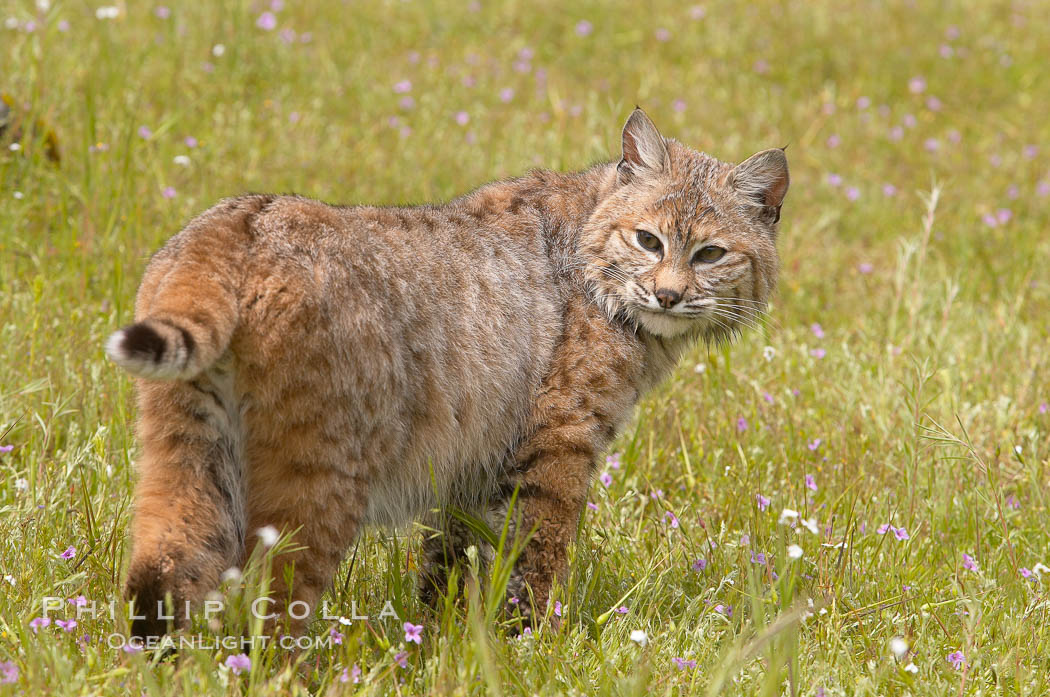

Bobcat, Sierra Nevada foothills, Mariposa, California

What do bobcats eat in the winter? Well, we almost had a chance to see for ourselves when one was stalking RMH the other day.

Though they are reported to range from 11 to 33 pounds, this particular one that visited us seemed even larger (though, we did not in fact try and weigh it). It did however have absolutely classic bobcat features…and it was hungry.

Apparently, hungry bobcats are much bolder, disregarding all indications that it was hunting around our house at 11AM, quite freely hopping over the fence around the pool area. Seems it was sure that Percy, our wandering, cage-less peacock would be a particularly delightful snack. Oh, it turns out that peacocks are in fact a great early warning system for some situations…like a bobcat in the yard.

Mouth watering, “Bobby” (or Bobbie, we didn’t check the sex either) sprang from his/her crouch toward the honking peacock; however, this particular cat was clearly uninformed on the nature of pool covers and wound up taking a chilly dip. Meanwhile, Percy had sprung for the roof, continuing his loud warning honking.

The cat slunk off before we had a chance to get the camera in position and hopefully has reconsidered our immediate front yard as a hunting ground.

The whole scene was utterly spectacular, a veritable “RMH Wild Kingdom.” I get a deep primal thrill with all the various opportunities to experience nature at RMH. And, though I am cautious by respecting nature, I really believe that we shouldn’t fear it. I don’t want our two pet dogs to become a meal opportunity, but I don’t roam about in fear or dread. Plus, drawing on the Disney concept of the “Circle of Life,” there’s a balance that must exist in nature, and that includes hungry bobcats.